
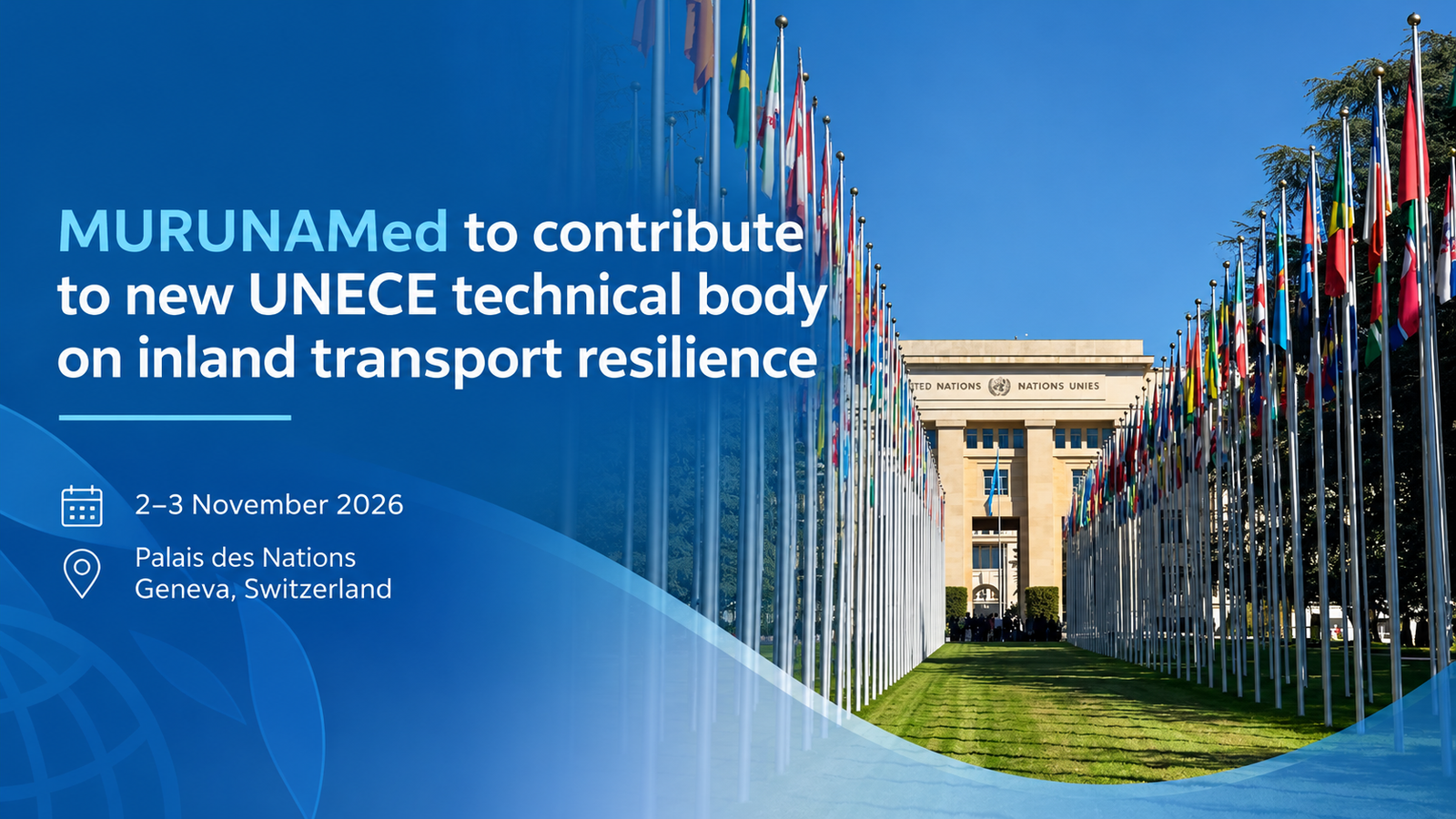
MURUNAMed to Contribute to New UNECE Technical Body on Inland Transport Resilience
The United Nations Economic Commission for Europe (UNECE) is launching a new Technical Body on Inland Transport Resilience (TB.1), creating a dedicated forum for international cooperation on strengthening transport systems against climate-related and other extreme events. CETMO will participate in its first session, sharing experiences and insights from the MURUNAMed project.
The growing impacts of climate change are placing transport networks under increasing pressure. Flooding, extreme heat, sea-level rise and other hazards can damage infrastructure, interrupt services and affect the movement of people and goods, making climate resilience an increasingly important priority for transport authorities.
Against this backdrop, UNECE is launching its new Technical Body on Inland Transport Resilience (TB.1). Its inaugural session will take place in Geneva on 2–3 November 2026
The new technical body succeeds UNECE’s Group of Experts on Assessment of Climate Change Impacts and Adaptation for Inland Transport, which examined the impacts of climate change on transport systems and approaches to adaptation. Between 2020 and 2025, the Group developed knowledge and practical tools to support transport authorities and professionals, including a stress-test framework, guidance for assessing the criticality of transport networks and assets, and approaches for developing adaptation pathways.
The establishment of a permanent technical body provides an opportunity to build on this work and further strengthen international cooperation on transport resilience.
Source: Pexels
From climate risks to practical resilience measures
The documents prepared for the first TB.1 session indicate some of the issues that will form part of its initial work. These include incident reporting, compound climate-hazard analysis and exposure mapping, and the interdependencies between transport networks and other systems.
Understanding these interdependencies is particularly important for climate adaptation. Transport networks depend on systems such as energy, telecommunications, water management and emergency services, meaning that the effects of an extreme event can extend well beyond an individual road, railway or transport asset.
The technical body also offers a platform for countries and experts to exchange knowledge, methodologies and practical experiences. Broad international participation can help ensure that discussions reflect different climatic conditions, infrastructure contexts and institutional capacities.
Bringing the MURUNAMed experience to the discussion
CETMO will participate in the first session of TB.1 to share experience and insights from MURUNAMed.
MURUNAMed supports Mediterranean Arab countries in strengthening the resilience of their transport systems to climate change. The project focuses on raising awareness, improving knowledge and laying the foundations for effective climate adaptation policies and actions.
Participation in the UNECE technical body will provide an opportunity to connect the lessons emerging from MURUNAMed with a wider international discussion on transport resilience. It will also enable the project to follow the development of new approaches, tools and practices that could be relevant to transport authorities across the Mediterranean.
This exchange is particularly valuable given the need to translate growing knowledge of climate risks into practical adaptation measures that can be incorporated into transport planning, infrastructure management and investment decisions.
Strengthening international exchange on transport resilience
Although the formal sessions of the technical body will take place in Geneva, much of its technical work is expected to continue through exchanges between meetings, creating opportunities for experts and authorities to remain engaged in its activities.
Authorities and institutions participating in MURUNAMed are therefore encouraged to follow the work of TB.1 and explore opportunities to contribute their own experience to this international exchange.
By connecting experiences from Mediterranean Arab countries with wider international work on climate adaptation, MURUNAMed can contribute to — and learn from — the growing body of knowledge on how to make transport systems more resilient to a changing climate.
The first session of the UNECE Technical Body on Inland Transport Resilience (TB.1) will take place in Geneva on 2–3 November 2026.